
Why Producing Countries Are Redefining Commodity Partnerships

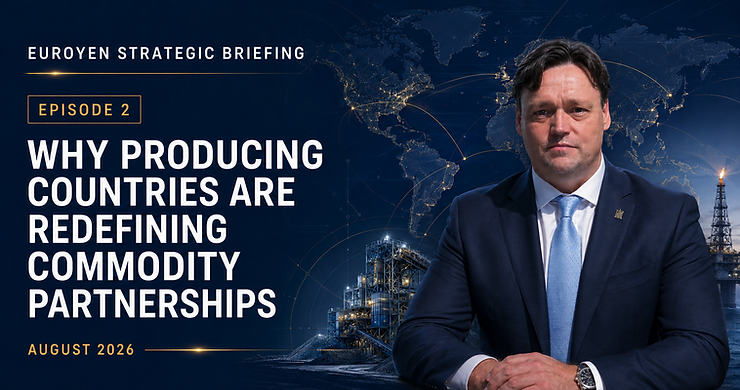
By Juan Cabrera | Euroyen Strategic Briefing — Episode 2
Resource-producing countries increasingly expect international commodity partnerships to deliver more than an immediate purchase.
The traditional model—extracting a commodity, exporting it and receiving the corresponding revenue—remains commercially important. However, governments increasingly recognise that much of the economic value is created after extraction through processing, refining, manufacturing, infrastructure, logistics and technology.
As a result, access to strategic resources is becoming connected with wider national objectives.
From raw-material exports to domestic value creation
Producing countries may seek investment in processing facilities, transport infrastructure and technical capability. They may also expect employment, skills development and more meaningful participation by national companies and local industries.
This changes the proposition for international buyers, investors and operators.
A prospective partner may require dependable long-term supply. The producing country may want investment, infrastructure and greater domestic value creation. Technical operators need regulatory clarity and commercially viable projects.
These objectives are not necessarily in conflict, but they do not align automatically.
Indonesia: access within an industrial framework
Indonesia illustrates how mineral access can become part of a wider industrial strategy.
The country holds substantial nickel, copper, tin, gold and bauxite resources. Its approach increasingly connects mineral development with domestic processing, government-supervised export channels, reference pricing and strategic industrial investment.
Cooperation with China across minerals, energy, green industry, transport and technology demonstrates how commodity relationships can develop into broader industrial frameworks.
For international partners, this changes the route to market. An apparent mine mandate or commodity allocation may be commercially insufficient if it does not comply with the country’s licensing, processing, export and pricing architecture.
Japan and JOGMEC: a sovereign-financing route
Japan is considering a different but complementary model.
Proposals to expand the authority of JOGMEC could allow the state institution to invest directly alongside foreign resource owners without first waiting for participation by a Japanese commercial company.
If adopted, this could create a more direct sovereign-financing route for strategically important mineral projects.
Japan could secure access to essential resources, while the producing country could obtain development capital, processing capability and a structured route into Japanese or allied supply chains.
Namibia is particularly relevant because JOGMEC has already demonstrated interest in its heavy-rare-earth potential.
Strategic interest alone, however, does not make a project investable. A credible proposition still requires verified mineral rights, reliable resource data, transparent ownership, a viable development plan, appropriate environmental and social controls and a defined route to market.
Petrobras and Ghana: institutional authority before procurement
The same principle applies to energy.
Petrobras, Brazil’s state-controlled energy company, has entered negotiations with Ghana concerning four offshore blocks in the Keta Basin.
This is not yet a signed petroleum agreement, drilling programme or procurement mandate. If negotiations progress, however, future requirements could include seismic capability, offshore engineering, drilling services, environmental work, marine logistics and qualified local participation.
The opportunity therefore depends on institutional authority, project development and capable technical partners—not simply access to decision-makers.
What credible partners must now contribute
Commodity partnerships are increasingly being constructed around several connected elements:
Security of supply
Project finance
Processing and refining
Infrastructure and logistics
Technology and technical services
Local participation
Long-term offtake
Access to institutional markets
International engagement must begin by identifying which institution possesses authority, what regulatory framework applies and whether the stated ambition has a credible route to implementation.
A memorandum of understanding is not a commercial agreement. Approval to negotiate is not a signed project. Proposed investment authority is not an approved funding commitment.
An identified resource is not necessarily an executable opportunity.
From access to alignment
The future of commodity access will increasingly depend on what an international partner can contribute beyond the immediate purchase.
The practical challenge is to align national priorities, technical capability, investment requirements and credible long-term offtake from the outset.
Euroyen operates across diplomatic, institutional and commercial environments, identifying where sovereign priorities and executable industrial capability can be brought together.
The strongest partnerships will combine dependable commodity supply with sustainable industrial and economic value in the producing country.
Institutional and principal-level enquiries: mandates@euroyengroup.com
WATCH THE FULL EUROYEN STRATEGIC BRIEFING
YouTube: https://youtu.be/Y9fzIiBsHTo
Euroyen Group operates at the intersection of diplomacy, sovereign markets and global industry. Euroyen Insights examines the developments reshaping international trade, strategic commodities, precious metals and institutional markets. This content is provided for information and market education only. It does not constitute investment, financial or legal advice.


